
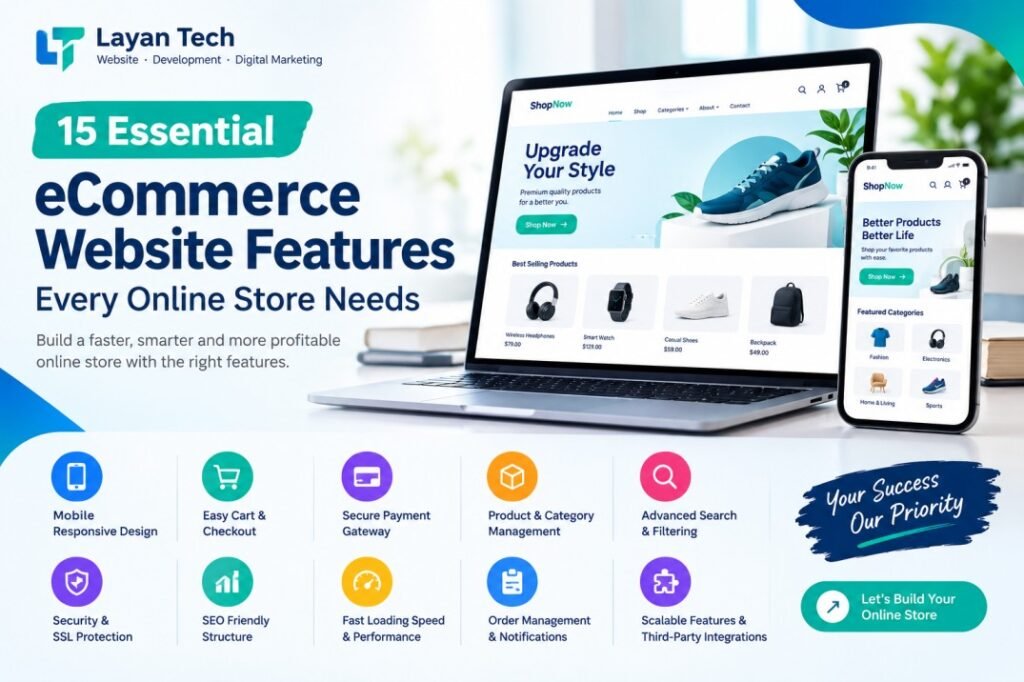
15 Essential eCommerce Website Features Every Online Store Needs
Launching an online store is an important step toward growing your business in the digital marketplace. However, a successful online store needs more than attractive product images and a beautiful homepage. It requires the right eCommerce website features to help customers find products, complete purchases, and enjoy a smooth shopping experience.
Whether you are starting a new online business or upgrading an existing store, choosing the right features can make your website easier to manage and more convenient for customers.
At Layan Tech, we provide professional website design and development solutions tailored to business goals. Our eCommerce development approach focuses on usability, responsive design, performance, and functionality to help businesses establish a stronger online presence.
In this guide, we explore 15 essential features to consider when building a professional eCommerce website.
1. Professional eCommerce Website Design
Your website is often one of the first places potential customers interact with your brand. A professional design helps communicate your brand identity and makes it easier for visitors to navigate your online store.
An effective eCommerce website design should include:
- A clean and organized homepage
- Clear navigation menus
- Well-structured product categories
- High-quality product images
- Consistent branding and typography
- Visible calls to action
- A simple and intuitive shopping experience
A visually appealing website is valuable, but its design should also help customers discover products and complete their purchases without unnecessary confusion.
2. Mobile-Responsive Website Design
Many customers browse online stores using smartphones and tablets. If your eCommerce website is difficult to use on smaller screens, potential customers may struggle to view products or complete checkout.
A mobile-responsive eCommerce website automatically adapts its layout to different screen sizes.
Important considerations include:
- Mobile-friendly navigation
- Readable product descriptions
- Properly sized buttons
- Responsive product galleries
- Easy-to-use shopping carts
- Convenient mobile checkout
At Layan Tech, we develop responsive website solutions designed to provide a consistent user experience across mobile devices, tablets, and desktop computers.
3. Product and Category Management
An organized product catalog makes it easier for customers to browse your inventory and find the products they need.
A professional online store should support convenient product management through an administration dashboard.
Depending on your business requirements, product management features may include:
- Product names and descriptions
- Product images and galleries
- Regular and sale prices
- Product variations such as size and color
- Product categories and subcategories
- SKU and stock information
- Featured products and related products
With a properly configured WooCommerce website, store owners can manage product information without needing a developer for every routine update.
4. Advanced Product Search and Filtering
Customers should not have to browse hundreds of products manually to find the right item.
A useful search and filtering system helps visitors narrow down their options based on relevant product attributes.
For example, an online clothing store might offer filters for size, color, brand, and price. An electronics store could allow customers to filter by manufacturer, specifications, or product type.
Depending on the store’s requirements, search and filtering features can include:
- Keyword-based product search
- Category filtering
- Price range filters
- Brand and attribute filters
- Product sorting
- Search suggestions
These features are especially useful for stores with large product catalogs.
5. Shopping Cart and Simple Checkout
The shopping cart allows customers to review selected products before placing an order. The checkout process then collects the information needed to complete the purchase.
A confusing checkout experience can discourage customers from finishing their orders.
To improve usability, consider including:
- Clear product names and prices
- Easy quantity adjustments
- Transparent shipping costs
- Simple billing and delivery forms
- Guest checkout, where appropriate
- Multiple supported payment options
- Clear order confirmation
The goal is to remove unnecessary steps while giving customers the information they need to make an informed purchase.
6. Secure Payment Gateway Integration
A reliable payment process is essential for building customer confidence.
Depending on your target market, payment options may include credit and debit cards, digital wallets, bank transfers, cash on delivery, or locally supported payment services.
For businesses serving customers in Bangladesh, integrations with services such as bKash and Nagad may be appropriate when supported by the selected gateway and website setup.
A payment integration project should consider:
- Provider compatibility
- Secure payment processing
- Transaction status updates
- Order confirmation
- Failed payment handling
- Refund procedures
- Clear payment instructions
The available payment methods depend on your business location, provider eligibility, and technical requirements. Your website should clearly communicate which options customers can use.
7. Inventory and Stock Management
Keeping track of stock manually becomes increasingly difficult as an online business grows.
An eCommerce website with inventory management capabilities can help store owners monitor product availability and maintain more accurate product listings.
Useful inventory features include:
- Stock quantity tracking
- Low-stock notifications
- Out-of-stock status
- SKU management
- Product variation stock
- Inventory updates following orders
When properly configured, inventory management can reduce manual work and help prevent orders for unavailable products.
8. Order Management and Notifications
An organized order management system helps business owners process purchases and monitor order progress.
With WooCommerce, store administrators can manage orders through a central dashboard and update order statuses as fulfillment progresses.
Depending on your requirements, an eCommerce website can include:
- Order history
- Customer order details
- Order status management
- Email notifications
- Invoice or receipt functionality
- Shipping and fulfillment information
- Order reports
Additional integrations can connect your store with supported courier services or other business systems to simplify fulfillment workflows.
9. Customer Accounts and Order History
Customer accounts make it easier for returning customers to interact with your online store.
Depending on the business model, account functionality can allow customers to:
- View previous orders
- Track order status
- Save delivery addresses
- Update account details
- Manage account information
- Access relevant order documents
Guest checkout can also be useful for customers who prefer not to create an account.
The right approach depends on your products, audience, and customer retention strategy.
10. SEO-Friendly eCommerce Website Structure
An attractive online store needs to be discoverable. Search engine optimization helps search engines understand your website and can improve its visibility for relevant product and category searches.
An SEO-friendly eCommerce website should consider:
- Descriptive product titles
- Unique product descriptions
- Search-friendly URLs
- Optimized title tags and meta descriptions
- Descriptive image alt text
- Logical product category structure
- XML sitemap configuration
- Canonical URL management
- Breadcrumb navigation
- Relevant structured data
For example, a descriptive product URL is generally more informative than a URL containing an unclear collection of numbers and parameters.
Technical SEO provides a foundation for organic visibility, but rankings depend on many factors, including content quality, competition, website authority, and ongoing optimization. No website feature can guarantee a particular Google ranking.
11. Fast Loading Speed and Performance Optimization
Website performance affects how customers experience your online store.
Slow-loading pages can make browsing frustrating, especially for customers using mobile devices or slower internet connections.
Important performance considerations include:
- Properly sized and compressed images
- Efficient caching
- Optimized CSS and JavaScript
- Reliable hosting
- Appropriate plugin selection
- Database optimization where needed
- Monitoring Core Web Vitals
Performance optimization should be based on actual testing rather than simply installing multiple speed plugins.
A faster, more responsive website can make it easier for customers to browse products and navigate checkout.
12. Security, SSL, and Regular Backups
An eCommerce website handles important business and customer information. Security should therefore be considered throughout development and ongoing maintenance.
Essential security practices include:
- HTTPS with a valid SSL/TLS certificate
- Regular WordPress, theme, and plugin updates
- Strong administrator passwords
- Appropriate user permissions
- Reliable backup procedures
- Security monitoring
- Secure payment gateway integrations
Backups are particularly important because they can help restore website data after certain technical failures or security incidents.
The exact security measures required depend on the website’s architecture, hosting environment, and integrations.
13. Discount Coupons and Promotional Offers
Promotional features can help businesses run seasonal campaigns and encourage customers to explore selected products.
Useful promotional options include:
- Coupon codes
- Percentage discounts
- Fixed-amount discounts
- Sale prices
- Minimum purchase requirements
- Product-specific promotions
- Free-shipping offers
- Scheduled campaigns
These features can be particularly helpful during holidays, product launches, and seasonal sales events.
Promotions should be planned carefully to protect profit margins and communicate offer conditions clearly.
14. Analytics and Conversion Tracking
Understanding customer behavior helps business owners make better decisions about their online stores.
Analytics tools can help measure how visitors discover the website, which products attract attention, and where customers leave the purchasing process.
Depending on the project, tracking solutions may include Google Analytics 4, Google Search Console, and advertising conversion tracking.
Useful measurements include:
- Website traffic sources
- Product page views
- Add-to-cart events
- Checkout activity
- Completed purchases
- Marketing campaign performance
Correct configuration and testing are important because inaccurate tracking can lead to misleading business decisions.
Analytics should also be implemented with appropriate privacy and consent practices for the markets you serve.
15. Scalable Features and Third-Party Integrations
Your business requirements may change as your online store grows.
Choosing a flexible eCommerce platform and planning integrations carefully can make it easier to introduce additional functionality later.
Depending on the project, advanced features may include:
- Courier and delivery integrations
- Customer support tools
- Email marketing integrations
- CRM connections
- Product review systems
- Wishlist functionality
- Multi-vendor marketplace capabilities
- Custom API integrations
- Advanced reporting
Not every store needs every feature from the beginning. Prioritizing essential functionality can help you launch efficiently while keeping future expansion in mind.
Why Choose WooCommerce for Your Online Store?
WooCommerce is an eCommerce platform built for WordPress. It allows businesses to manage products, orders, payments, and store content within a flexible website environment.
WooCommerce may be a suitable choice for businesses that want:
- Control over product and category management
- Flexible design customization
- Support for different product types
- Compatible payment and shipping integrations
- Content marketing and blogging capabilities
- Options for extending store functionality
The best platform depends on your business model, budget, expected traffic, operational requirements, and future plans. A WooCommerce store is not automatically the right solution for every project, so requirements should be evaluated before development begins.
How Much Does eCommerce Website Development Cost?
The cost of building an eCommerce website depends on its complexity and the features required.
Factors that can influence the project budget include:
- Custom design requirements
- Number of products and categories
- Payment gateway integration
- Courier and shipping functionality
- Advanced search and filtering
- Custom development and third-party APIs
- SEO and analytics configuration
- Security, maintenance, and support requirements
A straightforward online store generally requires a different level of investment from a large catalog or a custom multi-vendor marketplace.
Before starting development, prepare a list of required features and discuss your goals with an experienced website development team. This helps establish a realistic scope, timeline, and project quotation.
Build a Professional eCommerce Website with Layan Tech
Are you planning to launch an online store or upgrade your existing eCommerce website?
Layan Tech provides website design and development solutions tailored to business requirements. We focus on professional design, responsive layouts, useful store functionality, and performance-conscious development to help businesses establish a stronger online presence.
Our services can support your project with:
- Custom eCommerce website design and development
- WordPress and WooCommerce solutions
- Mobile-responsive website layouts
- Product and category management
- Compatible payment and third-party integrations
- SEO-friendly website structure
- Website performance optimization
- Ongoing website maintenance options
Whether you are starting a new online business or improving an existing store, we can discuss your requirements and help identify a suitable development approach.
Ready to Build Your Online Store?
Let’s discuss your products, business goals, required features, and budget to determine the right eCommerce website solution for your business.
Contact Layan Tech for a Free Consultation
Website: https://layantech.com/
Contact our team: https://layantech.com/contact/
Build an online store designed around your business needs and give your customers a more convenient way to shop online.
Frequently Asked Questions
What features should an eCommerce website have?
Essential features generally include product and category management, product search, a shopping cart, checkout, supported payment options, inventory management, order processing, mobile-responsive design, security, and an SEO-friendly structure.
Is WooCommerce suitable for small businesses?
WooCommerce can be a practical choice for many small businesses because it offers flexible store management and can be extended with compatible plugins and integrations. Suitability depends on the store’s requirements, maintenance needs, and budget.
Can I manage products without coding?
Yes. With a properly configured WooCommerce store, administrators can add products, edit prices, manage categories, update stock, and process orders through the WordPress dashboard without writing code for routine tasks.
Can an eCommerce website accept online payments?
Yes. A store can accept online payments through compatible payment gateways, subject to provider requirements, merchant eligibility, and the selected integration. Other options, such as cash on delivery, may also be available.
Does an eCommerce website need SEO?
SEO can help search engines discover and understand your product and category pages. Technical optimization, useful product content, and a clear website structure provide a foundation for organic search visibility, although rankings and sales cannot be guaranteed.
Can I add more features to my online store later?
Yes. Depending on the platform and technical architecture, you can add compatible payment services, shipping integrations, analytics, marketing tools, and custom functionality as your business requirements evolve.
How do I get started with Layan Tech?
Visit https://layantech.com/contact/ and share your business goals, product range, required features, and estimated budget. The team can discuss your requirements and help determine the next steps for your eCommerce website project.